Key Highlights
- India and Russia sign major agreements in labour, energy, health, and connectivity, anchored by Vision 2030.
- Connectivity corridors like INSTC, Northern Sea Route, and Chennai–Vladivostok emerge as the future of trade and investment.
- New initiatives under the 2030 program include training Indian seafarers for polar waters and building balanced, resilient supply chains.
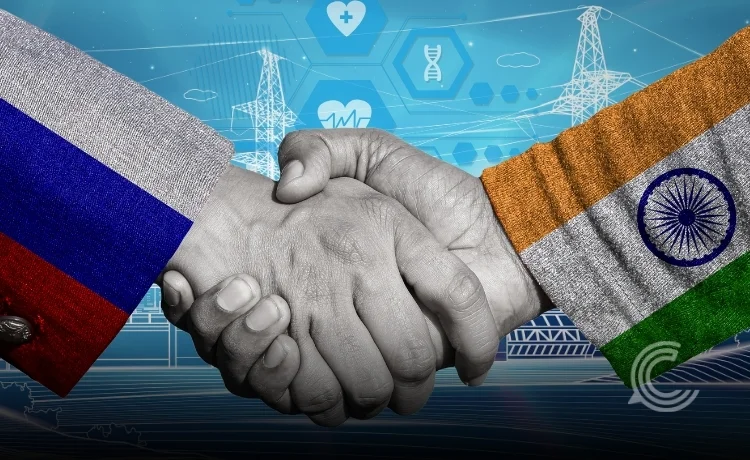
India and Russia signed a slate of landmark agreements on Friday spanning labour mobility, clean energy, health cooperation, and strategic connectivity following a bilateral meeting between Prime Minister Narendra Modi and Russian President Vladimir Putin.
India and Russia Seal New Deals in Energy, Labour, and Connectivity
Addressing a joint press conference, PM Modi highlighted that energy security remains one of the strongest anchors of the India–Russia partnership, adding that both sides will continue building “win-win cooperation” in the sector. As reported by PTI, he said the decades-long partnership in civil nuclear energy has “significantly contributed to clean energy generation” for India.
Energy Security, Critical Minerals, and the Push for Stable Supply Chains
Modi stressed that cooperation in critical minerals, which are now crucial to global supply chain resilience, has become a vital pillar of the partnership. As nations rush to secure lithium, cobalt, and rare earths, Russia’s reserves and willingness to engage in joint ventures provide India with a strategic edge.
Putin, thanking President Droupadi Murmu and PM Modi for a “warm and friendly welcome,” emphasised that connectivity is no longer just a priority but the future of how India and Russia will trade, invest, and collaborate.
He stressed three flagship routes that will redefine Eurasian logistics: the International North–South Transport Corridor (INSTC), Northern Sea Route and the Chennai–Vladivostok Maritime Corridor.
According to Russian officials, these corridors will reduce the transit time, enhance access to Central Asian and European markets, and open opportunities in shipping, maritime services, and logistics technology.
Connectivity as the New Engine of India–Russia Growth
Both nations signalled that the next decade belongs to connectivity-driven economic expansion, powered by Vision 2030 and new collaborative efforts. A key component is the 2030 Economic Cooperation Program, which aims to make bilateral trade more balanced, predictable, and diversified, addressing long-standing asymmetries in imports and exports.
In a significant forward-looking initiative, India and Russia will also begin training Indian seafarers to navigate polar waters, especially for cargo movement along the Northern Sea Route. Officials say this step will prepare Indian crews for Arctic shipping lanes and position India to become a serious player in polar maritime trade.
These moves reflect a shared belief in “future corridors” that can reshape the Indo-Pacific and Eurasian architecture of commerce.
A ‘Pole Star’ Partnership Through Eight Decades
PM Modi described the India–Russia relationship as a constant in a turbulent geopolitical landscape. “The world has witnessed many ups and downs in the last eight decades. However, the friendship between India and Russia has remained like a pole star, steadfast, reliable, and rooted in mutual trust,” he said.
Putin noted that Russia’s economic ties with India continue to grow. Bilateral trade increased 12% last year, setting a new record, and Moscow expects the figures this year to remain “at the same impressive level,” according to Russian press briefings.
Ukraine: India Reiterates Peace Stand
The Ukraine conflict also featured in the discussions. PM Modi reiterated India’s consistent stance: “We welcome all efforts for a peaceful and lasting resolution.” He said India has pushed for dialogue and de-escalation “from the very beginning,” according to officials present.
India continues to balance its deep strategic ties with Russia while increasing engagement with Europe and the US, positioning itself as a neutral but peace-driven actor.
Vision 2030 and Steps Toward a Free Trade Deal
A major highlight of the summit was the signing of the India–Russia Vision 2030 roadmap, detailing cooperation in defence, clean energy, manufacturing, digital public infrastructure, connectivity, and minerals. Both leaders will address the India–Russia Business Forum, where companies will explore opportunities in co-production and co-innovation.
Modi also confirmed fresh movement toward a Free Trade Agreement (FTA) with the Eurasian Economic Union (EAEU), a long-discussed but now fast-tracked initiative expected to reshape India’s access to markets across Russia, Armenia, Kazakhstan, Belarus, and Kyrgyzstan.