Key Points:
- ECB President Christine Lagarde confirmed that the foundational architecture for the digital euro is complete, following the end of a two-year preparation phase in late 2025.
- The project now moves into the political arena, requiring formal approval from the European Parliament and the European Council before any official issuance can occur.
- Proponents argue that a central bank digital currency is essential for Europe to maintain its monetary sovereignty against non-European payment providers and private stablecoins.
The European Central Bank (ECB) has reached a historic turning point in its quest to modernize the Eurozone’s financial infrastructure.
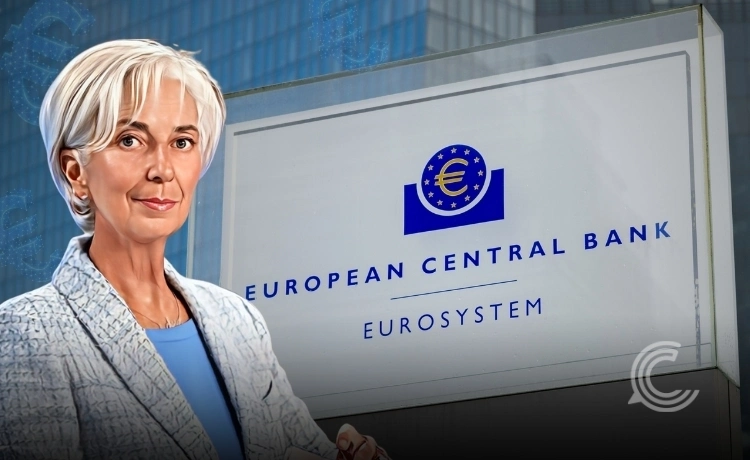
During a press conference in Frankfurt, ECB President Christine Lagarde announced that the technical groundwork for the digital euro is officially finished. The “heavy lifting” by central bankers is done; now, the currency’s fate rests in the hands of European legislators.
Central bankers have carried out the heavy lifting, it is now up to the European legislators to decide on the fate of the currency.
“We have done our work, we have carried the water,” Lagarde stated, as reported by Decrypt. She emphasized that the bank has built the systems and defined the safeguards, but the project cannot move forward without a legal mandate. “It’s now for the European Council and certainly later on for the European Parliament to identify whether the Commission proposal is satisfactory.”
The Engine is Built, the Road is Pending
For the past two years, the ECB has been in an intensive “preparation phase.” This involved designing a secure architecture, selecting infrastructure providers, and developing a “rulebook” to ensure the currency works seamlessly across 20 different countries.
Unlike decentralized cryptocurrencies, this central bank digital currency would be a direct claim on the ECB, much like physical cash but in a digital format.
According to Phemex News, the technical phase involved three pillars that included security, compatibility of the system, and privacy.
The ECB hopes to have digital euro alongside the physical banknotes, which would serve as an alternative to the private payment giants such as Visa and Mastercard, and other Silicon Valley-supported stablecoins.
The Reason Europe is Racing for a CBDC
The central bank digital currency movement is not just a convenience factor, but a geopolitical issue.
Presently, the European digital payment is being done by non-European firms on a larger scale. On many occasions, Lagarde has cautioned that the Eurozone was exposed to external economic shocks and policy alterations by depending on foreign infrastructure.
According to Lagarde, in the digital age, they have a goal to ensure that there is some currency that can be the stable point of the financial system, which she emphasized in the briefing.
The digital euro is considered to provide a high degree of privacy, which enables offline, peer-to-peer transactions, where there is no need to connect to the internet, aping the anonymity and resistance of physical money.
The Road to 2029
Even though it is technically ready, people will not be using digital euros on their phones tomorrow. Brussels has a reputation of being finicky in its legislative procedures.
Most sensitive topics still have to be discussed by lawmakers, including so-called holding limits, which should be approximately €3,000 per head, in order to avoid a huge outflow of money of the traditional commercial banks in the event of a crisis.
Based on the ECB progress reports, in case the European Parliament and the Council implement the required regulations by mid-2026, a complete rollout would be possible in 2029. This timeline accounts for the “realization phase,” where the central bank will conduct live testing with real users and merchants.
In the meantime, it is up to politicians to make the ball roll. The ECB has been able to establish the so-called digital engine, and without the legal key of EU legislators, the central bank digital currency is a high-tech prototype that awaits its first mile.