
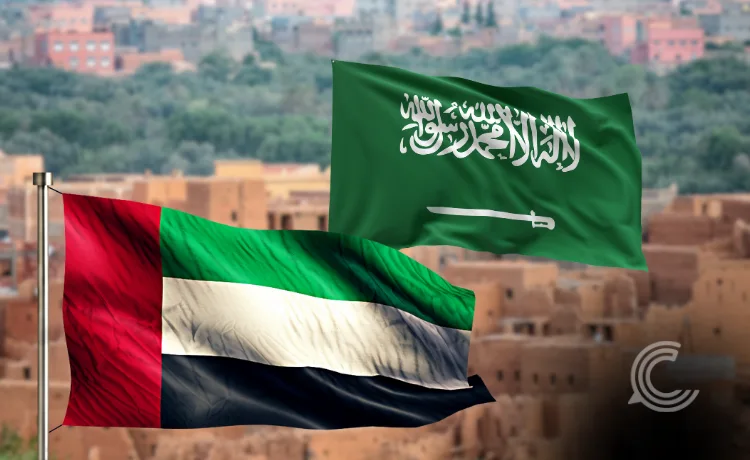
Key Points:
- The Saudi military launched overnight strikes on the port of Mukalla to destroy weapons shipments allegedly arriving from the UAE for separatist forces.
- Riyadh has declared that UAE-backed military advances in Hadramout and Al-Mahrah threaten the Kingdom’s national security and regional stability.
- Saudi Arabia has demanded a total withdrawal of UAE-linked forces from seized eastern provinces within 24 hours to restore the authority of Yemen’s unity government.
As the year 2026 draws to a close, a historic fracture has emerged within the Arab coalition, shifting the focus of the decade-long conflict from the Houthi rebels to a direct confrontation between former allies.
Saudi Arabia has officially accused the United Arab Emirates (UAE) of “extremely dangerous” actions in eastern Yemen, warning that it will no longer tolerate the violation of its established red lines.
The Mukalla Strike: A Turning Point in UAE-Yemen Tensions
The Yemen tensions reached a boiling point on Tuesday when the Saudi-led coalition conducted limited airstrikes on the port city of Mukalla.
According to a statement by Saudi Arabia’s Ministry of Foreign Affairs, the strikes targeted two vessels that had arrived from the UAE port of Fujairah.
The Saudi military alleged that the ships’ crews had disabled their tracking devices before offloading a “large amount of weapons and combat vehicles” intended for the Southern Transitional Council (STC).
“Given the danger and escalation posed by these weapons, which threaten security and stability, the Coalition Air Forces conducted a limited military operation,” the statement read.
While Saudi officials noted the attack was designed to avoid collateral damage, the strike marks the first time Riyadh has directly used air power to intercept assets linked to its Gulf partner, the UAE.
Riyadh Issues Stern Warning to Abu Dhabi
The geopolitical rift widened further as the Saudi Foreign Ministry issued a direct warning to Abu Dhabi. The statement linked the UAE to the STC’s recent territorial gains in the oil-rich Hadramout and Al-Mahrah governorates. These regions, which border Saudi Arabia, have long been considered a “red line” for the Kingdom.
In a public ultimatum, Riyadh called for the UAE to halt all financial and military support to separatist factions and demanded a full withdrawal of forces within 24 hours.
Saudi officials viewed the unchecked expansion of the STC as an “imminent threat” to the sovereignty of the internationally recognized Yemeni government.
The Struggle for Yemeni Unity
A primary driver of the current Yemen tensions is the fundamental disagreement over the country’s future. Saudi Arabia remains the primary champion of Yemeni unity, supporting the Presidential Leadership Council (PLC) and the “Nation Shield” forces to maintain a unified state.
Riyadh believes that a fragmented Yemen would create a power vacuum, potentially allowing extremist groups or Iranian influence to fester on its southern border.
Conversely, the UAE has historically supported the STC, which seeks to restore South Yemen as an independent state, a status it held from 1967 to 1990. This divergence in strategy has transformed the anti-Houthi coalition into a “war within a war,” with the two Gulf powers backing rival local militias.
Strategic Interests in Eastern Yemen
The escalation in Hadramout and Al-Mahrah is not merely about territory but about strategic control of Yemen’s resources and coastlines. As reported by The Guardian, the STC has recently pushed out Saudi-affiliated forces from several key areas, prompting the head of Yemen’s PLC, Rashad al-Alimi, to formally request Saudi intervention.
The Kingdom’s insistence on the UAE’s withdrawal reflects its fear that separatist control over eastern ports and oil fields would permanently dismantle the Yemeni state. For Saudi Arabia, supporting a unified Yemen is essential for securing its borders and ensuring that its long-term exit strategy from the war does not result in a divided, unstable neighbor.
Regional and Global Implications
The international community has watched the rising tensions with growing alarm. The Hindu reported that anti-Houthi forces in southern Yemen have declared a state of emergency, banning all border crossings and airport entries not authorized by Saudi Arabia.
In Washington, U.S. officials have called for restraint, fearing that infighting between coalition members will only benefit the Houthi rebels, who still control the capital, Sanaa.
While the UAE has previously expressed its commitment to Saudi-led de-escalation efforts, its silence following the Mukalla strikes suggests a deepening diplomatic impasse. As 15,000 Saudi-backed troops mass near the edges of STC-held territory, the risk of a full-scale proxy war between the two Gulf giants remains at an all-time high.