Myanmar to South Asia: How Election Laws Turn Into Political Weapons

Key Highlights
- Myanmar’s military junta plans to prosecute more than 200 people under new election laws ahead of military-run polls.
- Rights groups and the UN have dismissed the vote as a sham.
- Analysts warn the crackdown highlights how electoral laws can be weaponised, offering lessons for fragile democracies across Southeast Asia.
Myanmar’s military junta said on Wednesday it is seeking to prosecute more than 200 people for allegedly “disrupting” upcoming elections, deploying sweeping new legislation that rights monitors say is designed to crush dissent rather than protect democratic processes.
The announcement comes as the junta prepares to hold phased elections beginning December 28, presenting the vote as a step towards reconciliation after nearly four years of civil war triggered by the military’s 2021 coup.
However, opposition groups have vowed to block the polls in territories they control, while international observers have widely dismissed the elections as a façade intended to prolong military rule.
New Election Laws, Criminal Liability
Home Affairs Minister Tun Tun Naung said 229 people are being pursued for prosecution under a law introduced in July to shield the election from “obstruction, disruption and destruction,” according to state media.
The legislation criminalises criticism of the election, public protests and online dissent, with convictions carrying penalties of up to 10 years in prison. Some clauses allow for sentences of up to 20 years for offences such as damaging ballots or intimidating election officials.
Rights groups say the laws are being enforced aggressively, as reported by CNA. Several of the accused are activists or rebels operating outside junta-controlled areas, making it unlikely that all suspects are currently in custody.
Crackdown Intensifies Ahead of Voting
The military government last week said it was seeking the arrest of 10 activists involved in an anti-election protest in Mandalay, where pamphlets criticising the vote were thrown into the air.
Furthermore, recently a man was sentenced to seven years with hard labour for questioning the election on Facebook, while three artists, a director, an actor and a comedian were detained for allegedly undermining the vote through social media criticism, according to state media.
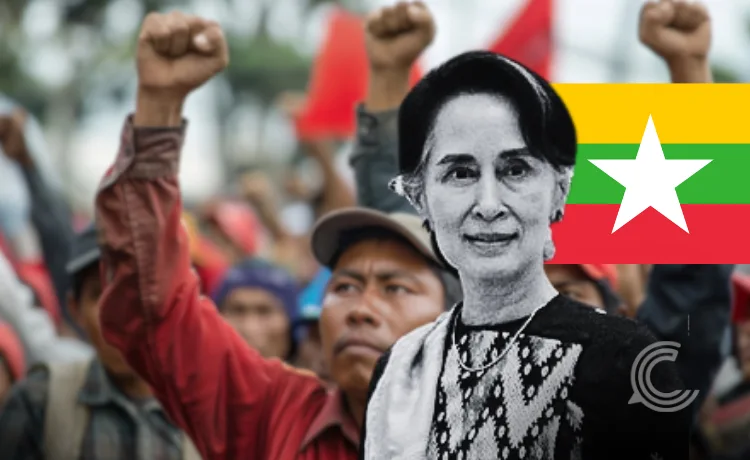
At least one individual has also been prosecuted for physically confronting an election organiser. Those jailed under the election law will join more than 22,000 political prisoners, including ousted civilian leader Aung San Suu Kyi, who remains imprisoned after her party’s landslide victory in the last election was overturned by the military.
UN Calls Vote a ‘Sham’
The United Nations’ special rapporteur on Myanmar, Tom Andrews, has repeatedly described the planned election as a “sham,” citing sweeping restrictions on free expression, assembly and political participation.
Myanmar’s military dissolved Suu Kyi’s party after alleging voter fraud claims that were never substantiated, and has since ruled by decree while battling resistance forces across large parts of the country.
As voting approaches, the junta is intensifying military operations to reclaim territory before the polls open. Results from the phased vote are expected by late January 2026.
How Electoral Laws Are Being Weaponised by the Regime
Myanmar’s election legislation illustrates how authoritarian regimes can repurpose electoral frameworks into instruments of repression. Rather than safeguarding democratic participation, the laws broadly criminalise dissent, criticism and peaceful protest under the guise of maintaining “order.”
Vague definitions of “disruption” allow authorities to selectively target activists, journalists and artists, while opaque courts ensure convictions are swift and difficult to challenge. In effect, elections become a tool to legitimise power, not transfer it.
Lessons for Democracies Across Southeast Asia
Myanmar’s experience offers a stark warning for democracies and hybrid regimes across Southeast Asia. Clear legal definitions of electoral offences, independent election commissions and judicial autonomy are essential safeguards against abuse. Without them, emergency powers and election laws can be selectively enforced to silence opposition under the banner of “stability.”
The crackdown also highlights the growing importance of protecting digital speech, as online platforms increasingly serve as the primary space for political engagement and repression in the region.
For Southeast Asia, the lesson is not only about Myanmar, but about how fragile institutions can be hollowed out from within when electoral laws are stripped of democratic intent.