Key Points:
- Elon Musk’s space venture, SpaceX, is preparing for a record 2026 IPO
- The IPO is projected to raise over $30 billion, surpassing the $29 billion record set by Saudi Aramco in 2019, with a potential valuation exceeding $1 trillion.
- The primary driver for the accelerated IPO is the robust, predictable revenue growth of its Starlink satellite internet service, which is projected to account for the majority of the company’s estimated $22–$24 billion revenue in 2026.
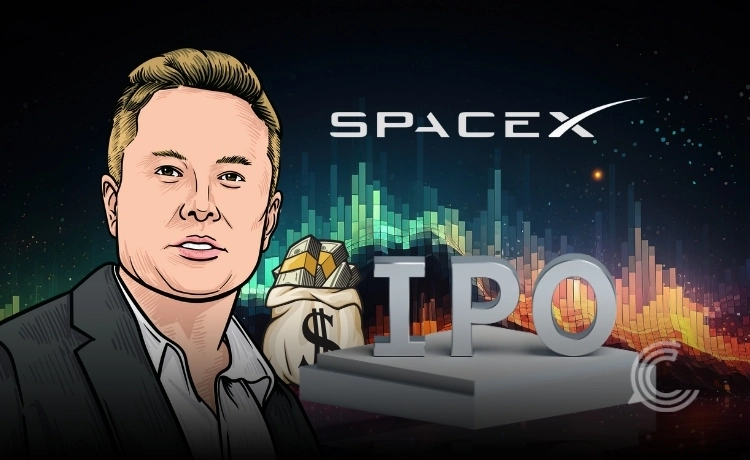
SpaceX, the aerospace and satellite powerhouse founded by Elon Musk, is reportedly accelerating plans for what could be the largest Initial Public Offering (IPO) in history.
Recent reports, citing individuals familiar with the matter, said the company was targeting a public offering as early as mid-to-late 2026, seeking to raise significantly more than the initial $25 billion figure, with some estimates as high as over $30 billion.
The financial event is likely to value the entire company- Starlink included- at more than $1 trillion, overnight, making it one of the most valuable publicly traded companies in the world.
The Path to a Trillion-Dollar Valuation
The prospect of a SpaceX IPO has been a subject of intense speculation for years, with Elon Musk saying repeatedly that the company would remain private until its revenue streams were “smooth & predictable.” That condition seems to have been met by the exponential growth of Starlink.
Current internal share sales, finalized at the end of 2025, have already hinted at a soaring valuation, placing the per-share price over $800 billion, quickly challenging rivals like OpenAI for the title of world’s most valuable private company.
The over-$1 trillion IPO target reflects the market’s faith in two dominant pillars that have anchored the business model of this company: reliable rocket launch services and its global Starlink constellation.
SpaceX is on pace to earn around $15 billion in revenue for 2025, a figure forecasted to leap as high as $24 billion in 2026.
Such scaling financials, in addition to the success of its reusable Falcon 9 rocket system, has convinced executives to pursue a full-company IPO rather than the earlier proposed Starlink spin-off.
The Starlink Effect and Global Connectivity
Starlink, the financial engine making this mega IPO possible, is its satellite internet service. With an estimated 9,000 satellites deployed and more than 8 million subscribers across the globe as of late 2025, Starlink dominates the LEO communications market.
This is underpinned by strong growth momentum, with the securing of global spectrum rights for direct-to-mobile connectivity-a development noted by Elon Musk on X, formerly Twitter, back in December 2025.
Valuation increments are a function of progress with Starship and Starlink and securing global direct-to-cell spectrum that greatly increases our addressable market.” The expansion into “ending mobile dead zones” vastly expands its TAM.
New Capital, New Frontiers
The funds raised from the IPO are not intended to shore up its existing finances; Musk has confirmed that they will fuel the most futuristic endeavors of the company. Reports say a substantial portion will be invested in buying advanced chips and building space-based data centers.
An ambitious plan, it includes using the low-temperature vacuum of space to create computational infrastructure at hyper-efficiency-a concept that directly links SpaceX with the lucrative AI and data economy.
Proceeds from the IPO will help speed up development and testing of the Starship rocket, which would be important to NASA’s Artemis Moon missions, and eventually to Elon Musk’s ultimate aim of creating a self-sustaining city on Mars. The listing brings in public capital needed to de-risk these big multi-year projects.
The Musk Factor and Investor Risk
This is likely to be a very volatile IPO, with intense retail and institutional interest, driven more by the charismatic leadership of Elon Musk. His past companies, such as Tesla, illustrate the “Musk premium” whereby investor enthusiasm often moves well past traditional metrics.
But risks remain, its projected 2026 revenue of $24 billion against a $1.5 trillion valuation gives a very high Price-to-Sales of 62.5, demanding an aggressively high, sustained growth to justify.
Moreover, the unpredictable nature of aerospace technology, the regulatory hurdles for Starlink in various global markets, and Musk’s personal influence all contribute to an elevated risk profile, a factor public investors will have to weigh carefully.