
Key Highlights
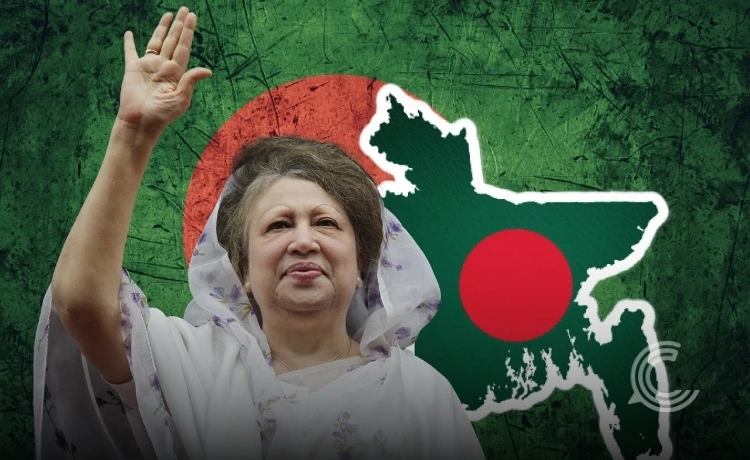
- Khaleda Zia, Bangladesh’s first female prime minister, has died at the age of 80 after a prolonged illness.
- Her decades-long rivalry with Sheikh Hasina has shaped Bangladesh’s political landscape for over 30 years.
- Her death comes amid political flux, with elections due in February and her party seen as the frontrunner.
Khaleda Zia, Bangladesh’s first female prime minister and a central figure in the country’s politics for more than three decades, died on Tuesday at the age of 80, according to her party.
The Bangladesh Nationalist Party (BNP) said she had been unwell for several years, suffering from multiple health conditions, including liver disease, diabetes, arthritis, and heart-related problems.
Bangladesh Loses a Longtime Political Leader
Her passing marks the end of a long political era shaped by sharp rivalry, repeated changes in government, and years of political tension. It also comes at a sensitive moment, with Bangladesh preparing for parliamentary elections scheduled for February.
Khaleda Zia: From Reluctant Politician to Prime Minister
Khaleda was initially far removed from politics. Friends and aides often described her as reserved and family-oriented, focused on raising her two sons until tragedy forced her into the political arena.
In 1981, her husband, President Ziaur Rahman, a former military leader and founder of the BNP, was assassinated during a failed army coup. Three years later, Khaleda took over the party leadership, vowing to continue her husband’s mission of economic reform and political independence.
Her political breakthrough arrived in 1991, when Bangladesh held its first widely recognised free election since military rule. Backed by a broad coalition that included Islamist parties, Khaleda defeated Sheikh Hasina of the Awami League to become the country’s first female prime minister.
The ‘Battling Begums’ Era
Khaleda’s victory marked the beginning of one of South Asia’s most enduring political rivalries. Alongside Hasina, the daughter of Bangladesh’s founding leader Sheikh Mujibur Rahman, she would dominate the country’s politics for more than three decades.
Their feud, often referred to as the era of the “Battling Begums,” saw power alternate between the BNP and the Awami League, punctuated by strikes, street violence, election boycotts and deep political polarisation. Supporters viewed Khaleda as dignified yet resolute, while critics accused her of enabling instability through confrontational politics.
Policy Legacy and Controversies
During her first term, Khaleda oversaw a shift from a presidential to a parliamentary system, strengthening the role of the prime minister. Her government lifted restrictions on foreign investment and introduced free and compulsory primary education, reforms that earned international attention.
However, her second term, which began in 2001 after a landslide election victory, was marred by rising militant violence and allegations of corruption. A 2004 grenade attack on a rally addressed by Hasina, which killed more than 20 people, became a turning point. Although Khaleda denied responsibility, her administration faced intense criticism, according to Reuters.
Imprisonment, Exile and Political Resilience
Following political unrest in 2006, an army-backed interim government jailed both Khaleda and Hasina on corruption charges. While Hasina later returned to power, Khaleda never regained office. She spent years in prison or under house arrest, while her party boycotted multiple elections.
However, after getting released in August 2024, following Hasina’s ouster during a student-led uprising. Earlier this year, Bangladesh’s Supreme Court acquitted her and her son, Tarique Rahman, of key corruption cases, clearing a path for the BNP’s political revival.
A Political Transition Underway
Khaleda had travelled to London in early 2025 for medical treatment and returned after four months. Her death comes as Bangladesh is governed by an interim administration led by Nobel laureate Muhammad Yunus, with elections scheduled to take place soon.
Her son, Tarique Rahman, who returned from nearly 17 years in exile last week, is widely seen as a potential prime ministerial candidate. While Khaleda had long been absent from frontline politics, her influence continued to shape the BNP’s identity and voter base.
As Bangladesh navigates another critical political transition, Khaleda Zia’s legacy, defined by power, imprisonment and enduring rivalry, remains deeply woven into the nation’s history.