Key Points:
- Thailand launched air strikes against Cambodian military positions after a border clash killed at least one Thai soldier
- The fighting represents the collapse of the Thailand-Cambodia Ceasefire agreement brokered by President Donald Trump in October 2025
- The core conflict stems from a century-old, undemarcated 817-kilometer border and nationalist claims over ancient Khmer temple complexes like Preah Vihear
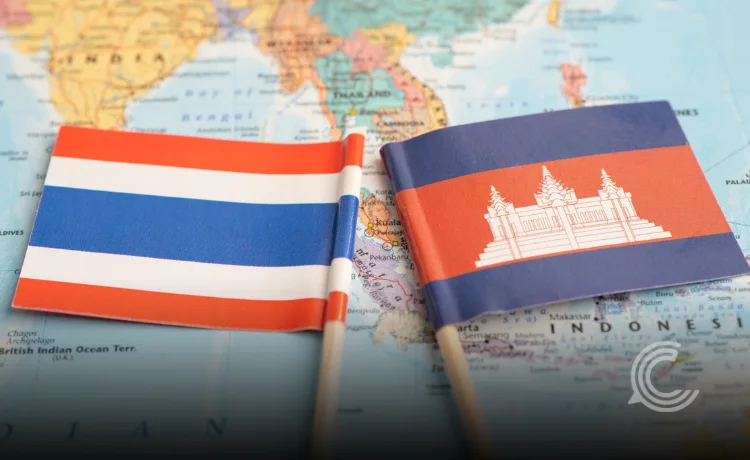
The fragile Thailand-Cambodia Ceasefire, a peace agreement brokered and witnessed by President Donald Trump, has definitively collapsed. Thailand’s military announced on Monday, December 8, 2025, that it had launched air strikes along the disputed eastern border with Cambodia, following deadly exchanges of fire.
The escalation marks the most serious breach of the peace accords and threatens to plunge the Southeast Asian neighbors back into the intense five-day conflict witnessed earlier this year.
The Collapse of a Fragile Peace
The recent aerial strikes in the easternmost province of Ubon Ratchathani follow days of escalating tension and a clear suspension of the truce agreement by Thailand. The Thai military stated the air strikes were launched “to suppress Cambodian supporting fire attacks” after Thai troops came under artillery and mortar fire, resulting in at least one fatality and several injuries.
Cambodia, however, maintains that Thai forces initiated the attacks, launching dawn raids on Cambodian positions and stressing that their troops had not retaliated to the initial strikes, Reported by The Associated Press.
This breakdown is particularly significant because the ceasefire was seen as a major diplomatic victory for U.S. President Donald Trump, who, alongside Malaysian Prime Minister Anwar Ibrahim, brokered the truce in July and then witnessed the signing of an expanded peace agreement in Kuala Lumpur in October 2025.
The Thailand-Cambodia Ceasefire began to unravel last month when a landmine blast injured a Thai soldier, leading Bangkok to halt the implementation of the peace pact. Thailand accused Cambodia of laying new mines to restart hostilities, a claim Phnom Penh denies, instead accusing Thailand of “numerous provocative actions,” as per The Guardian.
Trump’s Diplomatic “Success” Crumbles
The renewed fighting directly challenges the diplomatic efforts made by U.S. President Donald Trump, who personally engaged with leaders from both nations to secure peace. The initial Thailand-Cambodia Ceasefire was negotiated in July 2025 following five days of intense combat that killed dozens and displaced hundreds of thousands.
The expanded “Kuala Lumpur Peace Accord,” formally signed in October and witnessed by President Trump and Malaysian Prime Minister Anwar Ibrahim, was touted as a major diplomatic success.
However, the agreement has been fragile from the start. Tensions flared in November when Thai troops were injured by landmines, which prompted Thailand to announce a halt to the implementation of the peace agreement, arguing Cambodia had violated the spirit of the deal.
President Trump had previously claimed he “stopped a war” between the two nations through his mediation. The latest air strikes tragically illustrate that the diplomatic solution failed to address the underlying territorial volatility, causing the hard-won Thailand-Cambodia Ceasefire to crumble
The Roots of the Conflict
The current hostilities are merely the latest eruption in a territorial dispute that dates back over a century. The core disagreement lies in the ambiguity of the 817-kilometer border, which was first mapped in 1907 during French colonial rule in Cambodia. Thailand (then Siam) later contested the French-drawn maps, arguing they deviated from the agreed-upon watershed line of the Dangrek Mountains.
The most visible flashpoint is the 11th-century Preah Vihear temple complex. In a landmark 1962 ruling, the International Court of Justice (ICJ) awarded sovereignty over the temple itself to Cambodia, a decision reaffirmed in 2013, but which still fuels strong nationalist sentiment in Thailand.
The ongoing dispute also involves other ancient Khmer temples, such as Prasat Ta Muen Thom, and surrounding border territory, Reported by The Japan Times.
Humanitarian Impact and Political Fallout
The renewed military action comes only months after a brutal five-day conflict in July 2025, which tragically killed at least 48 people and displaced an estimated 300,000 civilians. The current fighting has prompted large-scale evacuations, with the Thai military reporting that over 385,000 civilians are being moved to temporary shelters across four border districts.
Cambodia’s former longtime leader, Hun Sen, father of the current Prime Minister Hun Manet, publicly urged Cambodian forces to exercise “restraint,” accusing Thailand of trying to provoke a massive retaliatory response.