Key Points:
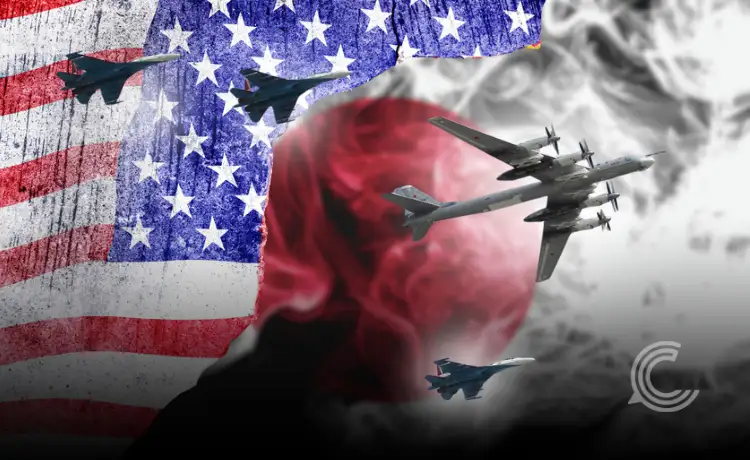
- Two U.S. B-52 strategic bombers flew in formation with six Japanese jets (F-35s and F-15s) over the Sea of Japan, signaling a rapid and robust alliance reaction.
- The joint action was preceded by the 10th China-Russia joint strategic air patrol, involving nuclear-capable bombers flying for eight hours over the East China Sea and Western Pacific, prompting scrambles from both Japan and South Korea.
- The repeated nature of these joint patrols is a clear indication that both blocs are actively refining their tactics and capabilities in a tense, high-stakes military competition.
In a clear and undisguised show of concerted military power, the United States used nuclear-capable B-52 strategic bombers to fly with the Japanese fighter jets over Japan Sea.
Tokyo confirmed the action on Thursday, in response to a large-scale joint strategic air patrol, conducted by Chinese bombers and Russian bombers around the territories of Japan and South Korean lands earlier this week.
The Sequence of Escalation
The series of actions started Tuesday as Chinese H-6 bombers and Russian Tu-95 strategic bombers made a long-range joint flight as they flew into the airspace of South Korea and Japan air defence identification zones (ADIZs).
According to The Moscow Times, the Russian Defense Ministry announced that the Russian bombers had flown eight hours across the Sea of Japan, the East China Sea, and the Western Pacific, with both countries having fighter planes that escorted the bombers.
Japanese Defence Ministry immediately scramled its fighter jets to monitor the aircraft saying that the operations were clearly aimed at demonstrating their power to our country, according to a posting on X by the Defence Minister Shinjiro Koizumi.
The proximity of the exercises to the territory of Japan especially in the Miyako Strait, one of the major international waterways, enhanced the national security issues of Tokyo.
The Response of Japan-U.S. Alliance
A joint flight on Wednesday by the U.S and Japan was a well prepared demonstration of the alliance preparation and capacity. The use of B-52 bombers, the main elements in the U.S. strategic arsenal, Japanese F-35 stealths and F-15 air-superiority fighters and ejection jets was designed to be highly visible and politically resonant.
According to reports, the allies reiterated that they were very determined not to allow any unilateral effort to alter the status quo through the use of force and that both the Self-Defence Forces (SDF) and the U.S. forces were on the readiness posture.
Taiwan and Regional Stability at Stake?
The recent military tensions are not isolated ones, but rather interwoven with the wider geopolitical tension in the area of Taiwan. The crisis was fueled last month when the Japanese Prime Minister Sanae Takaichi said it would be an existential threat to Japan, which depends on vital sea lanes around the island, to respond to an attack on Taiwan by China.
This position solidifies the link between Taiwan’s security and Japan’s self-defence, a point Beijing strongly disputes.
The joint patrol of China and Russia has several aims, for example, they not only enhance military operational interoperability between two countries, but also show that they are not afraid of American containment. Not just that, they also test the responsiveness and reaction time of the U.S. allies.
On one side is the China-Russia axis, which aims to demonstrate operational unity and challenge the existing U.S.-led security order. On the other stands the Japan-U.S. alliance, a cornerstone of the regional security framework, which is now actively demonstrating its layered capability for Indo-Pacific Deterrence, from conventional air superiority to nuclear-capable strategic projection.
The Geopolitics Bloc Formation
The ongoing rotation of such massive military drills proves the fragmentation of the Western Pacific to two different structures and rival security systems.
On the one hand is the axis of China and Russia that intends to show that they are working together and poses a threat to the current U.S. security order.
On the other is the Japan- U.S. alliance that is one of the foundations of the regional security system that is currently proving its multifaceted ability to protect the Indo-Pacific, both through conventional air supremacy to nuclear-capable strategic projection.