Trump Unveils Quantum Plan With 2031 Crypto Deadline

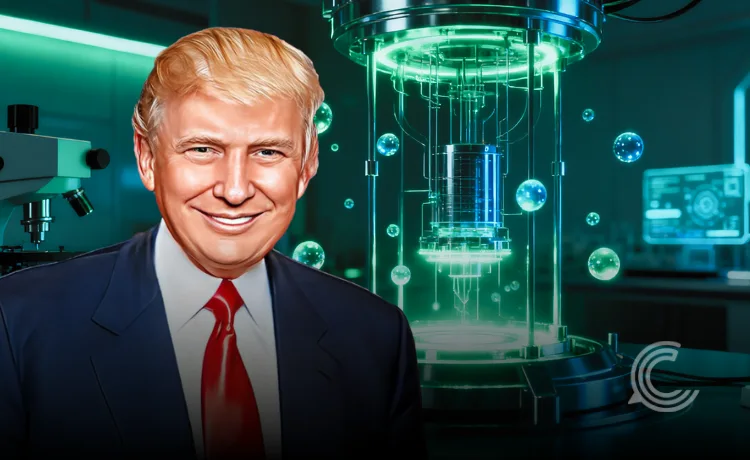
President Donald Trump has issued a major executive order on June 22, 2026, which is specifically designed to accelerate U.S. leadership in quantum technologies and harden federal systems against future quantum attacks. The directive lays out a plan to build a science-grade quantum computer, deploy quantum sensors and networks, grow the quantum sensors and networks, grow the quantum workforce, supply chains, and require federal migration to post-quantum cryptography by 2031.
What Is In The Order
The order tasks the White House science adviser, working with Energy, Defense, Commerce, NASA and the intelligence community, to update the National Quantum Strategy and set bold national goals. Agencies are asked to look at the requirements for the first “science-enabling” quantum computer, a machine that is intended to open doors for new discoveries and not just simple benchmarks, and to produce system specifications and resource estimates.
Agencies must also plan to deploy quantum-enabled sensors and networks within five years, signalling a push to move quantum tech out of labs and into operational use across government. The administration is reviving the National Quantum Initiative Advisory Committee and expanding the Quantum Counterintelligence Protection Team, indicating a mix of R&D acceleration and security hardening.
Why it Matters
Quantum computing and sensing are widely seen as transformative. Faster molecule simulations could speed drug discovery, new sensing capabilities can improve the navigation and detection part, and quantum-driven optimization can reshuffle manufacturing and logistics. For the U.S., the order is a bet that early investments, tight industry partnerships, and secure supply chains will preserve a strategic advantage.
A notable, concrete deadline in the order is a federal requirement to migrate to the U.S. Government systems to post-quantum computers powerful enough to break current public-key encryption remain uncertain, but government systems rely on long-term confidentiality. The policy is also pushing agencies to start replacing vulnerable crypto as of now, ahead of any realized threat.
Industry and Workforce Focus
The directive emphasizes partnerships with the U.S. industry and research institutions. It calls for expanding registered apprenticeships and credentials and creating National Quantum Workforce Development Institutes to build a pipeline of engineers, physicists, and technicians. The administration also wants plans to secure domestic manufacturing and supply chains for quantum components, from qubit processors to specialized cryogenics and photonics, plus funding support to build these capabilities.
Security and International Engagement
Along with commercialization goals, the order strengthens counterintelligence efforts around quantum programs and directs engagement with allies. This is a twofold strategy: accelerate civilian and commercial applications while preventing adversaries from stealing or subverting critical advances.
Reaction and Context
The White House says about $625 million has already flowed into major national quantum research institutes through public-private partnerships. Tech companies, including Google was present at the signing, and academic centres are likely to welcome clearer federal direction and funding commitments. But analysts also warned that building a science-enabling quantum computer and shifting entire federal cryptographic systems are complex, costly tasks that require sustained political and budgetary backing.
For the crypto world, the post-quantum crypto deadline is especially relevant. Exchanges, custody services, and protocol developers already observe post-quantum standards from NIST; the federal mandate will increase pressure on the private sector to accelerate migration planning and R&D into quantum-resistant algorithms.
Final Conclusion
The executive order that was signed yesterday marks a significant push within the U.S. market to turn quantum promise into operational reality. It pairs big R&D ambitions with practical timelines, including a firm migration to post-quantum cryptography for federal systems by 2031 and signals that quantum readiness is now a national priority across science, defense, industry, and crypto. Expect funding rounds, hiring drives, and faster industry-government partnerships as labs race from discovery toward deployment.