Zilliqa Warns Critical Ledger Bug Exposed Private Keys

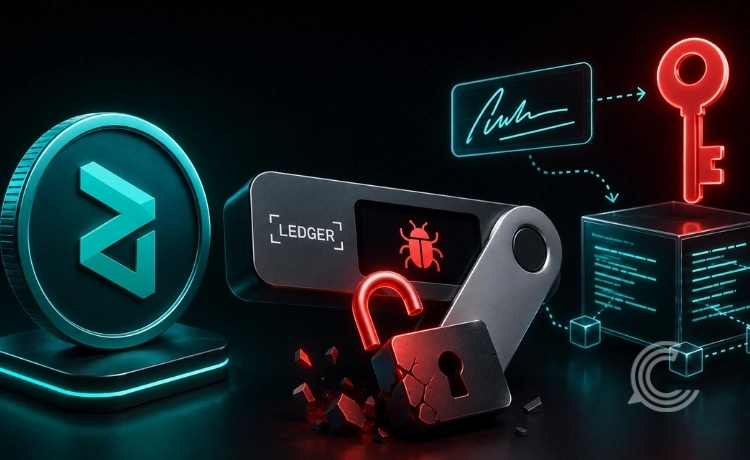
As reported by Zilliqa on its official X page today, July 22, 2026, a serious bug in the Zilliqa Ledger application has left some native (non-EVM) Zilliqa accounts exposed. This flaw has caused transaction signatures to use weakened ephemeral nonces (the temporary numbers that must be fully random for secure Schnorr signatures). Because these partial nonces leaked predictable bits, attackers can reconstruct affected private keys using only signatures that are already recorded on the blockchain.
Why This Matters
When a private key can be derived from past signatures, the account is permanently compromised. Updating the app will not undo past exposures. If an address has about five or more native Zilliqa transactions signed with a Ledger device using this app, treat that account as breached. Its private key can be recovered from on-chain data in seconds using readily available hardware.
Technical Root Cause
Zilliqa uses Schnorr signatures on the secp2561k1 curve, which requires a fresh, fully random 256-bit number called a nonce for every signature. The Ledger app attempted to produce such a nonce, but a programming mist took the wrong slice of bytes from the random output. This dropped eight bytes of entropy and left the top 64 bits of every nonce fixed at zero. Nonces were always smaller than 2^{192}, giving attackers a large, known bias to exploit.
How Attackers Can Use This?
Knowing 64 bits of each nonce creates a pattern attackers can exploit across multiple signatures. Using a well-known cryptographic method (solving the Hidden Number Problem with lattice reduction), an adversary can recover the private key after observing only a handful of affected signatures. Researchers observed on-chain activity consistent with such exploitation beginning 19 July 2026.
Scope and Limits of the Impact
- Affected: Private keys used to sign native Zilliqa transactions via the Ledger app.
- Unaffected: EVM transactions and Zilliqa SDKs, they produce nonces correctly.
- Time span: The bug existed in every released version of the Zilliqa Ledger app from 2019 through 2026, so the exposure is long-running.
Immediate Protective Measures Taken
Native Zilliqa transactions were suspended quickly to prevent ongoing theft while a fix was prepared. This pause stopped further draining of balances signed with the vulnerable app. A corrected Ledger app build that restores full-width nonce generation has been prepared in coordination with Ledger, but it cannot protect keys already used to sign the weakened signatures.
Even though these preventive steps were initiated, the price of the ZIL token still took a hit. At the time of writing, the price of the token stands at $0.002398 with a drop of 4.4% in the last 24-hours as per CoinGecko.
Timeline of Discovery and Response
2019-2026: The faulty code was present in every release of the Zilliqa Ledger app.
19 July 2026: On-chain behavior indicating active exploitation was noticed.
21 July 2026: Engineers isolated the bug due to incorrect nonce handling and reproduced the issue using public signatures.
Ongoing: A remediation plan to secure funds and retire affected keys is being finalized and will be communicated through official Zilliqa channels.
Acknowledgements and Coordination
KuCoin played a crucial role in discovering the main problem and demonstrated how private keys could be recovered from on-chain signatures. Their responsible disclosure and technical collaboration helped Zilliqa move quickly to limit further damage.
Final Thoughts
This is a rare but severe cryptographic mistake with long-lasting effects. If the users signed native Zilliqa transactions using a Ledger device at any time since 2019, assume that their key might be compromised and wait for official Zilliqa instructions before taking any action. The corrected app prevents new exposures, but compromised keys must be retired following the coordinated remediation plan.