Aster Executes First Buyback-and-Burn Under New Tokenomics

ASTER’s upgraded tokenomics just moved from plan to on-chain proof. The project announced today, June 29, 2026, on X that it has executed its first coordinated buyback-and-burn cycle under the new rules, buying back 2,937,125.53 $ASTER for stakers while simultaneously burning the same amount from the team allocation, a transaction now verifiable on Bscscan.
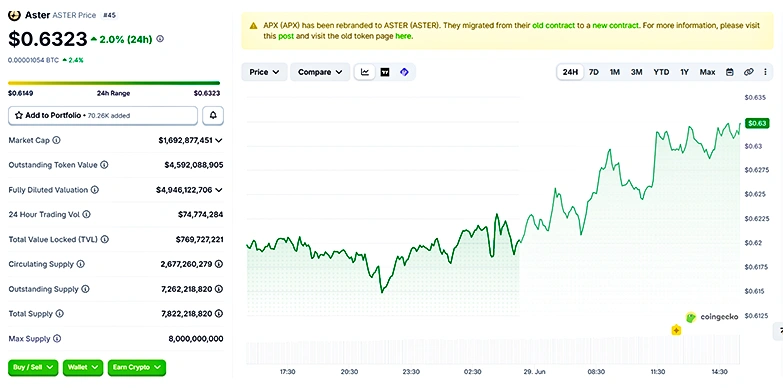
The market reacted immediately; however, it was measured. ASTER’s price did climb up after the announcement came in. At the time of writing, the price of the token stands at $0.6323 with an uptick of 2% in the last 24-hours as per CoinGecko.
For token holders and market observers, the move signals a stronger commitment to reducing circulating supply and aligning team incentives with long-term token health.
What Changed?
Old Setup: The team previously held a sizeable allocation that could be released or used in ways that created selling pressure.
New Tokenomics: A significant portion of protocol fees (99% of daily fees in the recent period) now automatically funds buybacks that are distributed to stakers. To balance supply, the team simultaneously burns an equal amount from its allocation.
Immediate Effect: Locked buybacks reward stakers while the matched burn reduces the team’s floating supply, and this creates a net deflationary pressure over time.
Why this Matters?
For everyday users and investors, there are two practical takeaways. First, regular buybacks increase demand-side pressure, since the protocol actively buys ASTER on the market. Second, matched burns shrink the supply coming from the team, reducing the risk of large token dumps that can depress price. Together, these mechanics are designed to create a healthier token economy and stronger alignment between the team and the community.
CEO and The Roadmap
Following the on-chain burn, CEO Leonard shared the update on social channels and called it “the first of many.” The tone of the announcement emphasized steady execution and a longer-term plan to continue coordinated buybacks and burns. The CEO’s comment aims to reassure holders that the team is committed to transparent, on-chain actions rather than off-chain promises.
Community Reception
Early reactions on social platforms were generally positive. Stakers welcomed the immediate buyback rewards, while broader holders liked the burn-as-proof that the team cannot indefinitely dilute supply. Skeptics noted that long-term effectiveness depends on sustained protocol revenue and disciplined team behaviours.
Other Developments
Aster, as we know, is a decentralized layer that combines on-chain governance, staking and market mechanics to create a permissionless, community-driven trading environment. It uses staked $ASTER to power validator-weighted decisions, aligns incentives through fee-driven buybacks for stakers, and enforces supply discipline via matched team burns, all designed to reduce centralized gatekeeping and boost on-chain transparency.
Recently, the platform opened a permissionless listing on Aster Spot. Here, any token that is already listed on Binance spot or Alpha can apply to be listed, and the decision is made through an on-chain validator vote weighted by staked $ASTER, using the same Listing Vote mechanism validators already run.
This development pushes Aster toward on-chain trading at the frontier: listings, approvals, and market access happen openly on a single open layer, removing intermediaries and letting token communities, traders, and stakers collectively decide which assets trade on Aster’s Spot market.
Final Thoughts
According to the post, ASTER’s first post-upgrade buyback-and-burn can be verified on-chain. Since it is verifiable, it gives solid evidence that the project is being executed as promised. The 2% price uptick reflects cautious optimism; the real test will be whether buybacks, burns, and fee generation hold up over time. If the team follows through on “first of many,” ASTER may well see gradually stronger supply-side support, but that outcome hinges on steady revenue and continued transparency.